SEO is dead, for real this time

Table of contents
Bare with me, this is not something that is made to grab your attention.
I’ve been doing SEO since I started doing stuff online. I started my first blog in 2017 when I was studying marketing. My friend asks me: “What do you like most in marketing?” I answer, “SEO”. I didn’t think twice. Now, during my 9 years of online experience, I changed a lot of paths, and just a few months ago, I actually decided to come back to marketing and offer SEO services. But not the one you think. It’s another SEO. Let me show you.
SEO (Search Engine Optimization) as it was
Before when I started 9 years ago, doing SEO meant optimizing your website for the engines like Google (especially), Bing, Yahoo!, etc. It was very simple. The only things you needed were a few:
- Fast website
- Mobile-optimized website
- Keyword staffed
- Meta descriptions
- H1 tags
- Long articles
- Internal link building
If you had a website on WordPress, like 89% of the internet was, it would simply install some SEO plugin like Yoast SEO, and the job would be 90% done. It was that easy that I was able to grow my first-ever blog to 15,000 readers in just 4 months after I understood the mechanism of Google. The other 10% was just to fix your technical part, and you were qualified to rank on Google on the first page. So basically SEO was the “tactic” with which you could be discovered from your customers that were typing on Google “X solution to …” (fill the blank). But today, in 2026, this is completely different. Algorithms have changed, and AI came in. So the SEO that we knew it do not exist anymore, this type of SEO is far gone. Death. Now we have a totally new SEO.
The new SEO (Search Experience Optimization)
The new SEO is different because people’s behaviors are different, especially after AI kicked in. I noticed this on myself too. Today we search differently and look at my behavior: I go to ChatGPT and search for a solution to grow muscles, I save the answer to come back later. The day later I ask the same to Gemini, then I continue on Google, I see the AI overview reply, maybe check Reddit to know what other people think of it and only then do I type on Google directly the solution that a mix of AIs suggested to me. Probably is the name of the brand that appeared multiple times. Probably the one adapted to my problem because of the context I gave AI. So once I’m on Google, I do actually want to find that thing in the first 3 results I get, and here is the crazy thing:
for my brain if I do not find your website in the first results, you do not exist and I go for the second solution I found.
I mean, I do this consciously, but it is an unconscious behavior of mine, like many people those days. That’s why if you want customers to find your solution, your brand, or your name, you need to use the Search Experience Optimization. This new type of SEO is the SEO you have to work on every single day. You need to optimize your reputation online. This includes:
Do the old SEO basics:
- Technical fixes on your website
- Insert the keywords in the right place of your page (please do not staff, as a general rule I use the 1%. If you write a 400-word page, using that keyword 4 times is enough)
- Mobile optimization
- Internal link building
- Avoiding 404
Do the new SEO:
Here you need to be present outside of your website.
First of all, allow crawling for AI to read your website.
Then some experts will suggest you use:
- Branded Reddit conversations
- Wikipedia pages
- Directories like G2, Captera, Clutch, etc.
- LinkedIn Articles
- X articles
- YouTube
because AIs fetch those websites, but honestly I would not rely on them that much. I’m not saying to not use them, in the short term, those have benefits, but more and more people are going for it. So platforms are actually being stuffed with fake reviews and poor-quality content just because companies want to be mentioned inside AI replies.
Doing this way, I believe that all of those platforms, like Reddit, will probably limit bots. So all the work you will be doing to be mentioned will be just a waste of time for the long-term goal. Using these platforms is good when it’s done in a genuine way, not to SPAM.
The real power of the new SEO
What I found most useful in my experience is to focus 80% on what you can control, your website. The old SEO is dead, but the basics are still here. The only thing is that blogs do not work anymore like before. People do not read blogs anymore unless there is something really useful for them there with real data and experience that they cannot find anywhere else. As it is today, blogs are the top of the funnel, useful for the information but not for the conversion.
My advice is to use what today are called the commercial pages (with commercial keywords).
Those pages are:
- Alternative pages
- Comparative pages
- Review pages
- Integration pages
- Princing page
- Vertical pages
- Listicle pages
These pages have a huge impact if you actually use the basics of the old SEO and use real data and information that converts people to buy from or book a call with you. Then the cherry on the cake is to add the new SEO tactics and build your authority also outside of your website.
My suggestion here: use the platforms that are complementary to the search. For example, YouTube is gold because it’s another search engine. Google will not limit bots from finding videos, and those videos have a superpower:
- help the discovery
- show your authenticity
- you can chapter them (meaning you can target more keywords, and Google might suggest them also if people look for different queries)
- are a hard barrier for spammers
There are many other examples, but in my opinion, it is better to pick the platforms that are really worth investing your time in and have a high rate of stability over time.
To wrap up
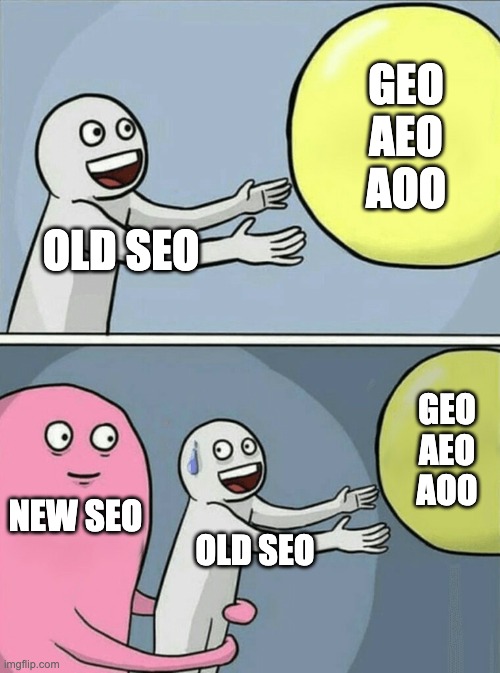
Search Engine Optimization became Search Experience Optimization, the work to do is mostly the same with toppings on it. You probably will hear GEO (Generative Engine Optimization), AEO (Answer Engine Optimization), AOO (AI Overview Optimization), and many more terms that are coming up, but do not confuse. As you read, those are just terminology of the same umbrella = SEO (Search Experience Optimization).
Thank you for reading till here,
Antonio.
PS. If you want help in implementing the new SEO, click the button below: